

I’ve been buy what I thought was “interesting” vintage junk (but I’m not a hoarder…is it suspicious I mentioned that so defensively?) for a long time now. But it didn’t occur me until now to actually do little write-ups on them.
I don’t know what year this device is from, but if I had to get I would say the mid to late ’80s – no faux wood grain (post-70s), no RF (composite common enough) and no S-Video (more of 90s thing). Only composite audio and video. It might actually be from the early 90s as the black plastic seems like it matches the style of the time (from stereo equipment etc).
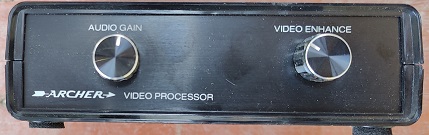
The tag line on the box is Provides adjustable audio and video signal gain for tailoring output to fit your system requirements. Archer, for those who may not know, was a “house brand” of RadioShack when it still existed. During that time I associated that brand with being overpriced and not exactly high quality. But electrics were much expensive back then so it’s no like I had a lot to compare it to. The only thing I can think of that I would would use it for – assuming it works – is a hilarious add-on for something like an old Raspberry Pi with composite video output.

Part of the appeal of these vintage gadgets is looking at the “through hole” size parts. None the flat-as-paper surface mount packages of later periods. You can see and identify ever resister, transistor, capacitor and diode.
So I was going to open it up and see what makes it work. Unless it’s a 2 inch square PCB with a surface mount chip connected to some potentiometers. That won’t be very exciting.
Opening it up
As it turns out I still confused about what year this could be from considering the quality of the board inside the device. And it also reminds why I never had that high of an opinion about the RadioShack brand.

I was right on one thing though: it does use all through-hole components and they connect to potentiometers (okay that was given).
And all the parts I would expect are there: transistors, resistors, capacitors and shortcuts to ground since it’s the 80s and quality control is over rated.
Not that I’m a qualified just or anything, but this isn’t actually that bad of quality especially if speed and making it as cheaply as possible was the priority. Even in the 80s this is probably only a few dollars of standard parts. No custom logic chips or anything, just a bunch of “off the shelf” parts. I mean the solder joints aren’t exactly great but if it still works after ~40 years who am I to judge? Why all the extra through-holes though? They re-used a board from another product, didn’t they? Maybe that’s the reason this product exists: too mean of these boards in a warehouse some place. Slap some resisters on to a board and release it as a “video processor”. Make sure to charge at least $70! Radio shack gets rid of some inventory, I get whatever a “video processor” is…everybody wins.
Then I saw the underside of the board.
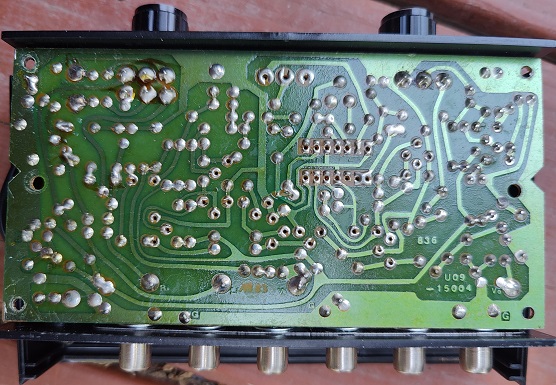
This looks like the most horrible armature job I think I’ve seen. What’s the deal with those traces? Did they design it on a cocktail napkin in 10 minutes? And I think it was hand soldered.
But it does demonstrate why I buy and open up these random vintage gadgets: I can could likely trace the connection of every component and reproduce this on a breadboard if I wanted to. I mean I don’t know why I would want to. But with a multi-meter and some patience I think I could.
Now all I have to do is connect a device to it and connect it to a TV to see if turning the knobs change the video quality in some way. And hopefully doesn’t burst into flames.
Update: after writing this entry, I did a search for this came up with this YouTube video about what must have been a later model. The narrator of the video mentions getting the device in 1986 so the one I have must be from 1980? Or just the budget version of the 1986 model. Because the model in the video has lots of toggle switches and buttons and apparently some actual ICs on the board. That could be what some of those through-holes are for: one of those chips.

Other entries on “vintage junk” can be found under the “vintage hardware” tag.
 Tildes on the side